The Horse That Remade the Plains
A Family Could Only Own What It Could Carry
That is the rule that governed life on the Great Plains before the horse arrived, and it explains almost everything that came after. A camp on the move traveled at the speed of women and dogs. The dog travois — two poles lashed into an A-frame, dragged behind the animal — carried a modest bundle a modest distance. Lodges were small because lodge covers had to be carried. Bison were hunted on foot, often by driving a herd toward a cliff or into a corral, a method that took an entire community and a great deal of luck.
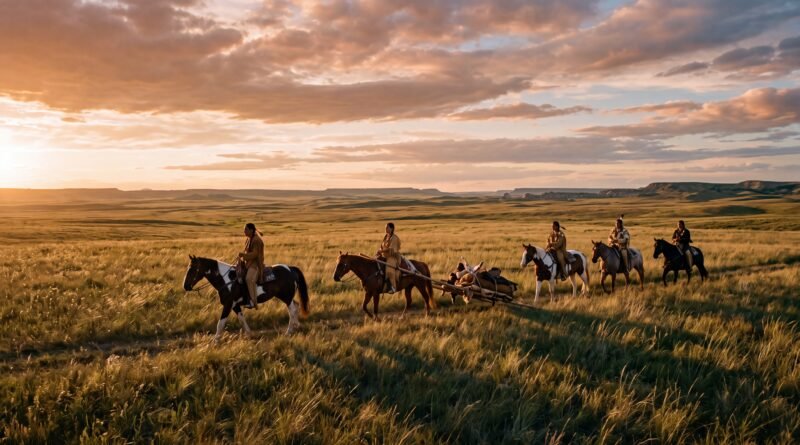
Then, over roughly one century, that entire calculation changed. A horse could pull about four times the load of a dog and cover about twice the distance in a day. Lodges grew. Camps ranged further from the river valleys. A hunter could ride into a running herd and take what his family needed in an afternoon. The mounted Plains world that fills every painting and every film — that world is younger than the United States Constitution.
Quick Answers
Were horses native to North America?
Native horses lived here in the Ice Age and died out thousands of years ago. Every horse in this story descends from animals brought by Spanish colonists beginning in the 1500s.
How did Plains nations get them?
Through trade, through raiding, and by capturing animals that had gone wild and formed their own herds. Very few came directly from Spanish hands.
How long did the classic horse culture last?
The Smithsonian’s own exhibition on the subject calls it “brilliant but brief, lasting just over a century.” It crested around 1840.
The Story Every Book Told — And What Changed in 2023
For most of the twentieth century the account went like this. On 10 August 1680, Pueblo peoples led by the Tewa religious leader Popé rose against Spanish rule and drove the colonists out of Santa Fe. In the confusion, hundreds of horses — perhaps more than fifteen hundred — passed into Native hands, the largest single transfer to that point. From New Mexico the animals moved north along trade routes, nation to nation, until they reached the northern Plains.
That account is not wrong so much as incomplete. In April 2023 a study published in Science, written by nearly a hundred researchers including tribal historians from the Comanche, Pawnee, Lakota and Pueblo nations, examined horse remains from New Mexico, Wyoming, Kansas and Idaho using radiocarbon dating, isotope analysis and DNA. The animals were of Spanish ancestry. They had been bridled, ridden and cared for by Indigenous people. And they were in the northern Plains and Rockies by the early-to-mid 1600s — decades before the Pueblo Revolt.
Comanche historian Jimmy Arterberry, one of the study’s co-authors, noted that tribal oral history had said this all along: his people came across horses before they came across the Spanish.
This is worth pausing over. It is a case where oral tradition and laboratory science arrived at the same answer, and where the written record was the one that needed correcting.
Nation by Nation, Not All at Once
Popular articles tend to suggest that the Plains became mounted overnight. The documented dates say otherwise — the change rolled north across roughly three generations.
| Nation | Approximate arrival of horses |
|---|---|
| Jumano, Apache | by the 1650s |
| Ute, Comanche | around 1705 |
| Shoshone (Wyoming) | 1710s–1720s, through Comanche trade |
| Lakota | first contact around 1700; common in winter counts by 1715; in regular use by about 1750 |
| Crow | between about 1700 and 1735 |
| Nez Perce | around 1730, from the Shoshone |
| Columbia Plateau nations | still comparatively few when Lewis and Clark passed through in 1806 |
What Actually Changed in Camp
The hunt
Before horses, most Plains peoples stayed within reach of the river valleys, because chasing bison on foot across open grassland was slow, dangerous and unreliable. Mounted, a hunting party could travel to the herds instead of waiting for the herds to come to them, ride alongside a running animal, and bring back meat and hides in quantity. The bison hunt moved from being one part of the economy to being its center.
The camp itself
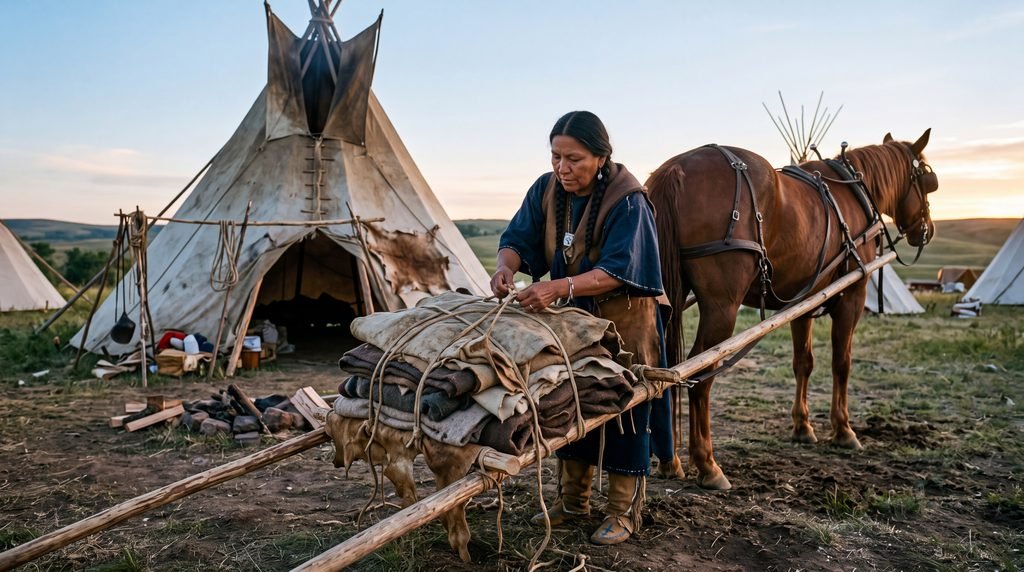
The horse travois carried what a dog never could. Lodge covers grew heavier and lodges grew larger. Families kept more — parfleches, robes, cooking gear, ceremonial items — because more could be moved. Moving camp went from an ordeal to a routine, and a fully nomadic life following the herds became practical for the first time.
Wealth, and who held it
Horses became the measure of standing. A Comanche ranchería of some 250 people might hold about a thousand horses and mules — roughly four animals per person. Among the Lakota, both men and women owned horses in their own right. Women managed the packing of the travois, a technical skill that carried real social esteem, and a horse could be the price paid for a woman’s beadwork.
It is worth resisting the tidy version of this, which says horses simply freed women from labor. What the sources describe is a shift in work, not its disappearance — and the details differ from nation to nation.
War
Mounted warfare reorganized how honor was won. Capturing an enemy’s horses became a form of combat in itself, and a young man’s reputation could be built on it. Riding skill became the measure of a fighting man — and by every account the officers who faced them left behind, the Plains nations produced light cavalry the equal of any in the world.
The Turn
By about 1840 the mounted bison-hunting culture had reached its height. And then the same animals that had built it began to work against it. By the 1840s and 1850s the great herds of horses were competing with the bison for the same grass and the same water in years of drought. The National Park Service notes that Comanche horse wealth — normally far too valuable politically, militarily and economically to be treated as food — sometimes had to be eaten in a crisis.
Then came commercial hide hunting, the railroads, the army and the reservation. The world that had taken a century to build was dismantled in under thirty years.
Why It Still Matters
The image most people carry — the mounted warrior, the feathered headdress, the pony at a gallop — is not a picture of an ancient, unchanging way of life. It is a photograph of one brilliant century, made possible by an animal that arrived from somewhere else, and cut short by forces that arrived the same way. Understanding that does not diminish the Plains nations. It shows how quickly and how skillfully they took an entirely new technology and built a civilization on it.
Sources
- Smithsonian National Museum of the American Indian, A Song for the Horse Nation
- National Park Service, The Plains Indians and Comanches and Horses
- Taylor, W. T. T. et al., “Early dispersal of domestic horses into the Great Plains and northern Rockies,” Science, 2023
- North Dakota Studies, Lakota Horses
- Montana Office of Public Instruction, Crow Timeline
- Discovering Lewis & Clark, Indian Horses in the Pacific Northwest
Related: The Three Sisters: the field that fed a confederacy